Friday, 18 July 2014
Ztylus Camera Case & Lens kit for Apple iPhone 5/5S
Probably, there are more photographs taken with cameras in mobile phones than any other class of camera. With their lack of a zoom lens, its not surprising that so many add on lenses have been developed.
Ztylus has developed case & multi-lens combinations for a number of phones, including Samsung Galaxy & iPhones. Their latest, for the iPhone 5/5S, has a unique arrangement of fish-eye, wide-angle, macro & polariser.
http://dailytekk.com/2014/07/09/ztylus-iphone-camera-case-and-revolver-lens-kit-review/
http://www.gizmag.com/ztylus-smartphone-camera-case-lens-system/32724/
http://ztylus.com/ / extra weight bulk smart phone smart-phone smartphone Ztylus stylish case protect iPhone Note 3 S4 circular mount multiple lens system attached cell mobile four additional lens options case and lens system expand photographic capability case aircraft-grade aluminum polycarbonate integrated kickstand Revolver interchangeable lens systems Samsung Galaxy S4 Galaxy Note 3 iPhone 5/5S black white circular polarizer lens /


Thursday, 17 July 2014
Google Street View finds gas leaks

Gas leaks in Boston
Credit: Environmental Defense Fund
Methane is a greenhouse gas. Many times worse than carbon dioxide. Around 120 times. Being combustible, it doesn't persist long in the atmosphere. It combines with oxygen to form carbon dioxide, which still isn't good — just less bad.
Methane is the major component of natural gas. One use of natural gas is domestic heating & cooking. It gets to homes through pipes laid in the ground. As the pipes age, they start to leak. This is not normally a fire risk. But we don't want methane in the atmosphere.
Google & Environmental Defense Fund have co-operated in a pilot project to fit methane sensors to 3 Street View cars.
http://www.edf.org/climate/methanemaps
http://www.digitaltrends.com/cool-tech/google-uses-its-street-view-cars-to-sniff-out-gas-leaks/#!bgNYyN / street streets Boston Staten Island Indianapolis Google’s Street View cars collecting panoramic imagery fitted with methane sensors cars sniffing out natural gas leaks hazard affects many cities world wide US Environmental Defense Fund EDF Google Earth Outreach conduct pilot project Street View cars gathering 15 million readings thousands of leaks utility pipes beneath the streets providing officials data on pollution used to be invisible EDF’s Fred Krupp data has been added to maps Boston older city with older pipes most leaks Indianapolis newer pipes Staten Island number of located leaks immediate threat to safety utilities monitor deal with the more serious ones powerful effect on the global climate warming effect carbon dioxide climate change global warming greenhouse effect gas plug leaks leak reduce near-term climate impacts inexpensive sensors cloud computing data analysis social media transforming environmental protection /
Wednesday, 16 July 2014
Malaria control: X marks the spot
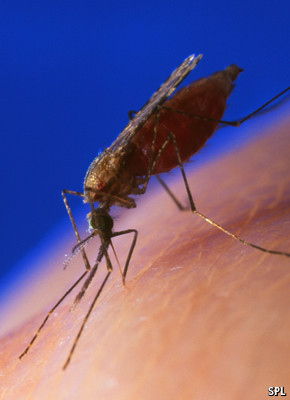
Credit: SPL/The Economist
After 5,000 years, malaria remains a major disease of humanity. Every minute, a child dies from malaria & it remains a major cause of poverty worldwide, due to effects such as worker productivity, absenteeism, premature mortality & medical costs.
Now there is hope that a genetic approach may lead to control of Anopheles gambiae, a major species of the mosquito which carries the malaria parasite.
http://www.economist.com/news/science-and-technology/21604092-how-get-mosquitoes-breed-themselves-death-x-marks-spot
_______________________
Other references:
http://www.who.int/features/factfiles/malaria/en/
http://www.nature.com/nature/journal/v415/n6872/full/415680a.html / mosquito kill disease control controlling malaria insecticides eliminate malaria selective selectively killing transmits parasite mosquitoes genus Anopheles Nikolai Windbichler Andrea Crisanti Imperial College London paper Nature Communications females break the chain of transmission drink blood pass the parasite on longer term because females population cannot reproduce researchers’ trick engineer mosquitoes gene protein called homing endonuclease genetic parasite cut particular sequences of DNA damages chromosome destroy destroys chromosome copy copies endonuclease gene repair site homing parasitism homing endonuclease species of slime mould X chromosome destroying chromosome completely humans X chromosomes Y males unfertilised egg sperm cell transplanting endonuclease gene genomes male mosquitoes spermatogenesis researchers population caged populations experimented in the wild will break the chain of transmission natural selection parasite has gone reintroduced disruption to the local ecology /
Tuesday, 15 July 2014
Retinal scanner for Samsung Galaxy Note 4?

Credit: Samsung/BGR
A cryptic tweet from a Samsung account, which includes the image above, reads in part, "Security can be improved using features unique to us,” has lead BGR to speculate that the new Note 4 will include an, "eye scanner".
http://bgr.com/2014/07/14/galaxy-note-4-specs-eye-scanner/ / Samsung's sales starting to slow increased competition low end of the smartphone market saturation at the high end hit company profit declined third consecutive quarter several huge adjustments launch new high-end phones truly compelling differentiation combat Apple’s upcoming iPhone 6 handsets flagship phone Galaxy S5 soon-to-be-announced Galaxy Note 4 recent tweet official Samsung account new key Galaxy Note 4 image eye most secure smartphones hot topic unlock unlocking specs quad-core or octa-core processor 2K display 3GB RAM 32GB 16-megapixel rear camera 4-megapixel front-facing camera /
Monday, 14 July 2014
The effect of breastfeeding on infants
It has long been known that human breast milk has a positive outcome for baby's immune, & neurological development, but recent research is showing that breast milk of a mother nursing a male baby is different than that of a mother nursing a female baby & composition of breast milk can have impacts on baby's behaviour months later.
Read the transcript, stream, or download the podcast at:
http://www.abc.net.au/radionational/programs/healthreport/the-effect-of-breastfeeding-on-infants/5587144 / mother's breast milk contributes contribution immunological immune system neurobiological neurological neural behaviour behavioural develop development research researchers University of Chicago investigate investigation investigating how variation mother mother's milk shapes infant temperament behaviour post-natal post natal life adult adulthood /
Read the transcript, stream, or download the podcast at:
http://www.abc.net.au/radionational/programs/healthreport/the-effect-of-breastfeeding-on-infants/5587144 / mother's breast milk contributes contribution immunological immune system neurobiological neurological neural behaviour behavioural develop development research researchers University of Chicago investigate investigation investigating how variation mother mother's milk shapes infant temperament behaviour post-natal post natal life adult adulthood /
Sunday, 13 July 2014
Human memory-saving devices get $40m research boost
DARPA (Defense Advanced Research Projects Agency) has granted $40 million for research into brain function & dysfunction, as in epilepsy, memory loss & Alzheimer's.
Initial research will be with epilepsy sufferers to locate the origin of their attacks.
Ultimate aim is to develop brain implants to restore function in brains affected by epilepsy, traumatic brain injury & Alzheimer's.
http://www.wired.co.uk/news/archive/2014-07/11/memory / team creating devices stimulate brain restore memory function grant granted $37.5 million £21.9 million Darpa develop technology people with epilepsy implants locate seizures originate researchers reuse data gathered monitor other brain activity patterns brain stores and retrieves memories memory map patterns record recording brain activity epilepsy sufferers mild memory problems play a computer game remembering pattern differences between best worst scores patents will be used develop algorithm personalised stimulation pattern keep brain performing perform performance optimal level wipe erase restore memories memory rat small device implanted into the brain record analyse electrical activity real time deliver stimulation brain brains brain's entorhinal cortex feeds information hippocampus evidence side effects precautions minimise disruption other areas of the brain extremely low levels of stimulation treat different types memory loss Alzheimer's disease device restore memories lost enhance ability form retrieve new memories team Michael Kahana University of Pennsylvania /
Saturday, 12 July 2014
"Factory wipe" — does it make the data on your phone safe from prying eyes?
You're about to dispose of your old phone, so, to protect your privacy, do a factory reset & all you data is gone. Right?
Well, maybe. Exactly what is gone depends on the age of the phone & the version of the operating system it runs. On an Android phone the index into your data is erased. For most purposes, this is enough. But the data is still there & is recoverable by those with the tools & know-how.
If our phone runs Android 3.0 or later, there is a way around this.
Since 3.0, Android has included optional encryption of the phone. Encryption requires a user-supplied key without which data on the phone is unreadable. So before doing the factory reset, encrypt the phone. The factory reset will erase both the index into the data & the encryption key. Your data still won't be erased, but it will unreadable even to someone who has the know-how to recover it.
Apart from the first few versions of iOS, encryption of data has been automatic, so a factory reset will make your data irrecoverable. Earlier versions overwrite user data, so, either way, you're safe.
http://www.theguardian.com/technology/2014/jul/11/factory-wipe-on-android-phones-left-naked-selfie-photos-and-worse-researchers-find / hundreds of naked selfies intimate pictures men women found batch Android smartphones owners thought they had wiped research study studying 20 handsets security company Avast factory reset function Android phones doesn't delete data on the phone retrieved using standard forensic security tools researches said found 40,000 photos 750 photos of women various stages of undress 250 photos male anatomy EXIF data picture file details location residence previous owners' identity file data Settings function doesn't actually wipe the data storage on the phone wipes the index points locations storage data is written sufficient accessing data forensic tools access storage areas Avast reconstruct the files Google Ars Technica research older devices versions Android security protections versions running software before Android 4.0 vulnerable Google's Android documentation setting file encryption is optional newer devices vulnerable Android 3.0 onwards encrypt the phone cryptographic key user-provided passcode factory reset delete the key rendering the data unreadable Google's spokesperson recommended disposing device enable encryption carry out a factory reset Apple iPhone iPad encrypt data AES 256 algorithm software key generated information user erase all content and settings cryptographic key deleted encrypted beyond any capability to decode existing data partition /
Well, maybe. Exactly what is gone depends on the age of the phone & the version of the operating system it runs. On an Android phone the index into your data is erased. For most purposes, this is enough. But the data is still there & is recoverable by those with the tools & know-how.
If our phone runs Android 3.0 or later, there is a way around this.
Since 3.0, Android has included optional encryption of the phone. Encryption requires a user-supplied key without which data on the phone is unreadable. So before doing the factory reset, encrypt the phone. The factory reset will erase both the index into the data & the encryption key. Your data still won't be erased, but it will unreadable even to someone who has the know-how to recover it.
Apart from the first few versions of iOS, encryption of data has been automatic, so a factory reset will make your data irrecoverable. Earlier versions overwrite user data, so, either way, you're safe.
http://www.theguardian.com/technology/2014/jul/11/factory-wipe-on-android-phones-left-naked-selfie-photos-and-worse-researchers-find / hundreds of naked selfies intimate pictures men women found batch Android smartphones owners thought they had wiped research study studying 20 handsets security company Avast factory reset function Android phones doesn't delete data on the phone retrieved using standard forensic security tools researches said found 40,000 photos 750 photos of women various stages of undress 250 photos male anatomy EXIF data picture file details location residence previous owners' identity file data Settings function doesn't actually wipe the data storage on the phone wipes the index points locations storage data is written sufficient accessing data forensic tools access storage areas Avast reconstruct the files Google Ars Technica research older devices versions Android security protections versions running software before Android 4.0 vulnerable Google's Android documentation setting file encryption is optional newer devices vulnerable Android 3.0 onwards encrypt the phone cryptographic key user-provided passcode factory reset delete the key rendering the data unreadable Google's spokesperson recommended disposing device enable encryption carry out a factory reset Apple iPhone iPad encrypt data AES 256 algorithm software key generated information user erase all content and settings cryptographic key deleted encrypted beyond any capability to decode existing data partition /
Subscribe to:
Posts (Atom)