Tuesday, 13 January 2015
GM 200-mile-range electric vehicle (update)
General Motors has shown off a concept version of its long-promised 200-mile-range electric vehicle (EV) at the Detroit Auto Show.
http://www.wsj.com/articles/gm-readies-electric-rival-to-tesla-1420859986
Bolt is the name of the new GM vehicle. John Voelker of Green Car Reports believes he has a privileged perspective on the likely confusion arising from the similarity in the names Bolt & Volt:
http://www.greencarreports.com/news/1096166_why-bolt-is-a-really-terrible-name-for-chevys-electric-car
In fact, there is little new here. GM’s 200-mile-range EV & its 2016 release, has been widely reported previously. All that has been shown is a concept. A production vehicle won’t be available until 2016, & may bear little similarity to the vehicle at the Detroit Auto Show. Take a look at Volt concept versions.
Despite the fact that there is little new in the GM announcement, it has led Seeking Alpha to predict the end of the line for Tesla in an article headed: “GM's 200-Mile Electric Car For $30,000: RIP Tesla”
http://seekingalpha.com/article/2811785-gms-200-mile-electric-car-for-30000-rip-tesla
Update: What is new: Green Car Reports indicates that the price will actually be $37,500 & the launch date, "... during 2017, likely as a 2018 model." http://www.greencarreports.com/news/1096238_chevrolet-bolt-concept-200-mile-30000-electric-car-concept-live-video-photos
What has been missed in the discussion so far, is that those unfamiliar with EVs have two major concerns:
1. range anxiety — range less than 100 miles won’t be enough for day-to-day use & will leave them stranded — in practice this goes away within a few weeks of ownership
2. cross country driving — relatively short range, combined with slow charge times1 mean cross country travel will be slower than buyers accustomed to a range of hundreds of miles & five minute refuelling want to accept
Obviously, the 200-mile-range of the Bolt answers question 1., but no apparent answer for question 2.
Where does all of the above leave Tesla?
● Tesla’s Model III EV with 200-mile-range is scheduled for release in a similar time frame, & at a similar price to the GM vehicle
● Tesla’s Supercharger network with its promise of practical, free, cross-country travel remains a strong drawcard
● Elon Musk has hinted that the Model III will have good performance —
Tesla dropped the 40 kWh Model S because it was "sluggish" & "didn't feel like a Tesla". He has also criticised the performance of other EVs & has said that he wants to release a Model III that, “doesn’t suck”.
● if Tesla never sells a single Model III, in the Model S, they have: a luxury sports sedan — the best car Consumer Reports has ever tested — with an extremely loyal following — a waiting list for every car produced — cheap to run — & continues to be developed
Tesla has thrown open its patents. Elon Musk has said that he is prepared to negotiate with other vehicle manufacturers for use of the Supercharger network. He has also made it clear that other manufacturers would have to cover costs.
Elon Musk — where would the failure of Tesla leave him? Certainly not poor. He has made a great deal of money, but he has consistently claimed that the money is secondary. What he set out the achieve with Tesla, was to create a sustainable system of personal transport. And he has already done that.
__________
1 Wayne Cunningham: “Slow, fast, & faster: Where to charge electric cars”, Cnet, http://www.cnet.com/news/slow-fast-and-faster-where-to-charge-electric-cars/


Monday, 12 January 2015
Time is an illusion

Credit: NASA/ESA/The Hubble Heritage/The Daily Mail
Although possibly not the first, Douglas Adams said, or at least wrote: "Time is an illusion.”*
He was almost certainly the first to add: “Lunchtime doubly so."*
While failing to address the, “Lunchtime doubly so," clause, Dr. Nikodem Poplawski** explains that time is an illusion ultimately created by living inside a black hole:
http://www.insidescience.org/content/every-black-hole-contains-new-universe/566
http://www.technologyreview.com/view/419827/why-our-universe-must-have-been-born-inside-a-black-hole/
http://www.dailygalaxy.com/my_weblog/2011/05/new-theory-black-holes-give-birth-to-new-universes-todays-most-popular.html
__________
* Douglas Adams: “The Hitchhiker's Guide to the Galaxy”, Chapter 2
"Time is an illusion. Lunchtime doubly so."
"Very deep," said Arthur, "you should send that in to the Reader's Digest. They've got a page for people like you."
** Dr. Nikodem Poplawski, Department of Mathematics & Physics, University of New Haven, http://www.nikodempoplawski.com// our universe may exist inside a black hole may sound strangebest explanation how the universe began observe today theory explored past few decades physicists unsolved questions big bang theory Universe singularity infinitely small point containing high concentration of matter expanding inflation suer fast super-fast expansion space slight lumps concentration matter early universe coalesced large celestial bodies galaxies clusters galaxies theories source dark energy speed up its expansion black hole answers physics general relativity modern theory of gravity largest scales any event occurs as a point in space and time spacetime massive object Sun distorts curves spacetime gravitational dent alters motion Earth other planets orbiting force of gravity quantum mechanics smallest scales atom quantum mechanics general relativity single theoryquantum gravity subatomic particles black holes Einstein-Cartan-Sciama-Kibble theory of gravity Universe quantum property spin particles atoms electrons internal angular momentum torsion two dimensional canvas flexible one dimensional rod bending rod corresponds curving spacetime twisting the rod spacetime torsion early universe black holes extreme environments spacetime torsion manifest repulsive force counter counters attractive gravitational force spacetime curvature very massive stars collapse collapsing black holes light escape strong prevent matter from compressing point of infinite density extremely large finite density energy converted mass immensely high gravitational energy extremely dense state production of particles greatly increasing the mass inside the black hole spin higher levels of spacetime torsion repulsive torsion stop the collapse big bounce recoil expanding universe universe's shape geometry distribution of mass every black hole would produce a new baby universe inside our own universe interior of a black hole existing in another universe motion of matter black hole's boundary event horizon only happen in one direction direction of time we perceive as moving forward times’s arrow of time inherited through torsion from the parent universe explain observed imbalance between matter antimatter Dr. Nikodem Poplawski theoretical physicist at the University of New Haven in Connecticut.
/
Sunday, 11 January 2015
Formula E, round 4, Buenos Aires, Argentina, Saturday 10 January 2015 (video)
Qualifying (1:17:40)
Race (55:32)
Complete results, including the race & qualifying:
http://www.fiaformulae.com/en/results/buenos-aires-eprix.aspx / Formula E Buenos Aires Argentina fourth race all electric racing series fourth race Buenos Aires Argentina open wheeler ePrix stadium races F1 FIA electricity sport electric vehicles EV terrific acceleration pass passing possible tracks with tight corners technology range race organizers identical cars Spark-Renault SRT_01E built French company Spark Racing Technology carbon fiber aluminum chassis Dallara electric powertrain electronics McLaren Electronics Systems Williams Advanced Engineering building 200 kiloWatt battery pack batteries powertrain generate 270 horsepower five-speed paddle shift gearbox fixed gear ratios Michelin 18 inch tires wet dry conditions sound 80 decibel whine full grid 20 cars FIA Formula E strategy street courses dedicated circuits tire wear grip management battery life charge prematurely testing drivers learn knowledge teams construction constructors constructing FanBoost pit stop second fully charged car advances in battery technology battery swaps charging battery Renault Michelin DHL Qualcomm Richard Branson Virgin Racing team Leonardo DiCaprio Venturi team lithium ion LiIon battery charge recharge range battery management system BMS /
Race (55:32)
Complete results, including the race & qualifying:
http://www.fiaformulae.com/en/results/buenos-aires-eprix.aspx / Formula E Buenos Aires Argentina fourth race all electric racing series fourth race Buenos Aires Argentina open wheeler ePrix stadium races F1 FIA electricity sport electric vehicles EV terrific acceleration pass passing possible tracks with tight corners technology range race organizers identical cars Spark-Renault SRT_01E built French company Spark Racing Technology carbon fiber aluminum chassis Dallara electric powertrain electronics McLaren Electronics Systems Williams Advanced Engineering building 200 kiloWatt battery pack batteries powertrain generate 270 horsepower five-speed paddle shift gearbox fixed gear ratios Michelin 18 inch tires wet dry conditions sound 80 decibel whine full grid 20 cars FIA Formula E strategy street courses dedicated circuits tire wear grip management battery life charge prematurely testing drivers learn knowledge teams construction constructors constructing FanBoost pit stop second fully charged car advances in battery technology battery swaps charging battery Renault Michelin DHL Qualcomm Richard Branson Virgin Racing team Leonardo DiCaprio Venturi team lithium ion LiIon battery charge recharge range battery management system BMS /
Saturday, 10 January 2015
Reversible USB Type-C finally on its way, alongside USB 3.1’s 10Gbit performance

Credit: ExtremeTech
CES generates a lot of hype about new & interesting gadgets. This year, less spectacular, but more significant than most, is the new USB Type-C connector & associated USB 3.1 standard.
Important new features include:
● reversible connectors
● more power (up from 10W to 100W) means that almost all peripherals can be powered directly by the USB connection — no more power brick for an external drive or USB hub
● higher data rates — up to twice as fast
http://www.extremetech.com/computing/197145-reversible-usb-type-c-finally-on-its-way-alongside-usb-3-1s-10gbit-performance#disqus_thread / CES show practical products USB Type-C connector USB 3.1 standard frustration connect USB devices computers Intel USB Type-C solve this problem universal connector that’s also capable of twice theoretical throughput USB 3.0 provide far more power hybrid cabling USB 3.1 cables backwards compatible disc USB 3.0 ports, Type-C adapters conventional USB new connector signal overhead drop significantly 128-bit and 132-bit encoding scheme PCI-Express 3.0 Type-C USB 3.1 Type-C plug previous standards USB manufacturers adopt expensive 3.0 hardware mobile devices cause confusion mistake one type of port for the other deploy technology mobile phones tablets interfaces consume more power USB controller can be powered down active drawing power PC charging port heat dissipation higher bandwidth higher heat 3W 4W specifications Watt 100W power envelope USB 3.1 more practical value 10Gbps bandwidth capability SSD enclosures conventional mechanical drives SSDs USB 2.0 hard drive slow compared to SATA power bricks connect points sufficiently reinforced external peripheral powered by single cables USB hubs multiple devices higher bandwidth flippable connector power provisioning competition Intel’s Thunderbolt high-speed standard bandwidth RAID TRIM motherboard add-on cards late 2015 early 2016 Type-C connectors disk disc drive /
Friday, 9 January 2015
Formula E, round 4 tomorrow — Buenos Aires, Argentina (update)
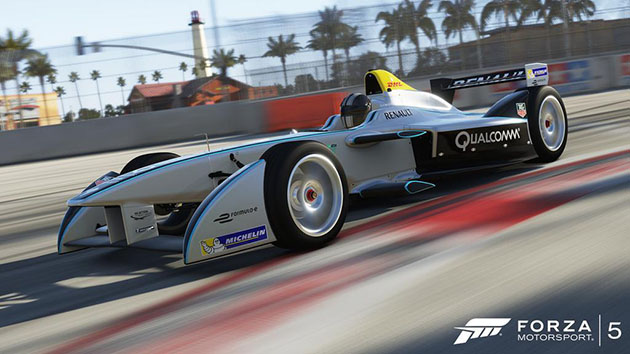
Credit: Forza Motorsport
Update: video of the entire race, plus qualifying at:
http://hhg2tech.blogspot.com.au/2015/01/formula-e-round-4-buenos-aires.html
Buenos Aires, Argentina
Round 4 - Saturday 10 January 2015
Practice 1 - 08:15-09:00 Buenos Aires local time
Practice 2 - 10:30-11:00
Qualifying - 12:00-12:55
Race - 16:00
FIA, Formula E web site:
http://www.fiaformulae.com/en.aspx / Formula E all electric racing series fourth 4th race Buenos Aires, Argentina ePrix stadium races F1 FIA electricity sport electric vehicles EV terrific acceleration pass passing possible tracks with tight corners technology range race organizers identical cars Spark-Renault SRT_01E built French company Spark Racing Technology carbon fiber aluminum chassis Dallara electric powertrain electronics McLaren Electronics Systems Williams Advanced Engineering building 200 kiloWatt battery pack batteries powertrain generate 270 horsepower five-speed paddle shift gearbox fixed gear ratios Michelin 18 inch tires wet dry conditions sound 80 decibel whine full grid 20 cars FIA Formula E strategy street courses dedicated circuits tire wear grip management battery life charge prematurely testing drivers learn knowledge teams construction constructors constructing FanBoost pit stop second fully charged car advances in battery technology battery swaps charging battery Renault Michelin DHL Qualcomm Richard Branson Virgin Racing team Leonardo DiCaprio Venturi team lithium ion LiIon battery charge recharge range battery management system BMS /
Thursday, 8 January 2015
Antibiotic drought may be over

Credit: BGLH
There are two problems with antibiotics:
1. lack of new antibiotics — since 1987, no new antibiotic has been approved for clinical practice
2. resistance — hence, “superbug” — e.g. antibiotic-resistant strains of tuberculosis
Together, these two problems have raised the spectre of a future without antibiotics.
Now, a new method of identifying new antibiotics has been developed. Twenty five antibiotics have so far been discovered, using this method, with the promise of more to come.
Teixobactin, most promising of the new antibiotics, works in a way not seen before: by attacking fats which are essential to building the cell wall of bacteria.
Because of this unique method of operation, it is hoped that resistance won’t be a problem. While there are reasons to hope that this may be true, similar claims have been made for many, if not all new antibiotics & antiseptics.
http://www.bbc.com/news/health-30657486
More on antibiotic-resistance:
http://www.abc.net.au/science/slab/antibiotics/superbugs.htm / decades long drought antibiotic discovery breakthrough US scientists novel method growing bacteria yielded 25 new antibiotics very promising new class antibiotics clinic discovered nearly three decades ago study Nature game changer game-changer experts antibiotic heyday antibiotic discovery 1950s and 1960s into doctor's hands microbes incredibly resistant extensiveley drug resistant tuburculosis medicine soil researchers researcher research Northeastern University Boston Massachusetts source nearly all antibiotics soil teeming with microbes grow grown laboratory lab team created subterranean hotel bacteria bacterium room device buried in soil unique chemistry of soil permeate room study scientists grow nearly half of all soil bacteria chemicals produced microbes dug up researcher's back yard tested for antimicrobial properties lead scientist Prof Kim Lewis 25 new antibiotics discovered method teixobactin latest most promising study shows uncultured cultured bacteria harbour novel chemistry not seen before promising source new antimicrobials revive field antibiotic discovery tests teixobactin toxic to bacteria not mammalian tissues clear deadly dose of MRSA tests on mice human tests needed researchers develop resistance teixobactin targets fats essential building bacterial cell wall difficult to evolve resistance antibiotic evolvedfree of resistance Professor Lewis several independent different tricks minimise resistance development /
Wednesday, 7 January 2015
Crude oil production costs up — petrol prices down — what's happening?

Credit: Eco News
Supply & demand tells us that rising costs of production lead to higher prices.
Crude oil is getting harder, & more expensive, to extract. Witness investment in tar sands & fracking.
Apparently in contradiction of the preceding 2 paragraphs, crude, petrol (gasolene) & other petroleum fuel prices are at long term lows.
Not surprisingly, those who have invested in the most expensive means of crude production are experiencing cost pressures, leading one commentator to claim that 97% of fracking operations are experiencing a loss at current oil prices:
http://m.dailykos.com/story/2015/01/06/1355814/-97-of-fracking-now-operating-at-a-loss-at-current-oil-prices#?detail=facebook
Gail Tverberg, an acturary interested in depletion of oil, natural gas, & water & climate change explains that decreasing quality of oil reserves accounts for falling prices:
http://ourfiniteworld.com/2014/12/29/how-increased-inefficiency-explains-falling-oil-prices/ / If the Saudis crush America America’s shale oil industry West Texas Intermediate 2014 peak $107.73 June dropping as low as $49.77 today New York Mercantile Exchange grade settled at $50.04 a barrel below break even break-even price 38 U.S. shale oilfields Bloomberg New Energy Finance shale oil fracking Canadian tar sand most expensive dirty oil production planet conventional Persian Gulf oil cheapest to produce Warren Henry spokesman Continental frackers spending money faster than they can make current oil prices not a sustainable long term trend Bob Tippeee editor Oil & Gas Journal Saudi Arabia Saudis no incentive lower supply defend price of crude oil not going to rescue the market other major producers Russia Iraq boosted oil production highest levels in decades seems certain low oil prices are here to stay at least for now oil patches red states Texas North Dakota projecting 100,000 layoffs energy sector slump painful regional recession Michael Feroli chief U.S. economist at JPMorgan Chase & Co. New York report Texas pumps 37 percent of U.S. oil output IEA International Energy Agency data show oil and gas industry effects housing other businesses majority of Texas energy production conventional means relies heavily on fracking oil rigs shut down U.S. rig count at risk R.T. Dukes an upstream analyst Wood Mackenzie Ltd. Houston tough year for operators employment support services oil and gas operations oil and gas extraction most job creation fracking industry comes up-front job losses before production falls most labor-intensive labor labour intensive oil-field industry construction and completion process new wells bulk of investment provides most income local economy ramifications oil slide companies will complete works in progress according to contract price began crashing layoffs notices Dallas Federal Reserve projects Texas slowdown state budgets Texas Wyoming Louisiana Oklahoma North Dakota Alaska oil sales production sold months years ahead of time temporary drop steep immediate effect when oil futures agreed geology traditional oil drilling shale oil taps out very quickly average decline world's conventional oil fields booming Bakken shale oil field production declines of 70 percent or more in the first year shale gas wells swift depletion rateso drillers plumbing new wells shortfall 2,500 new wells into production every year just to sustain production increasingly become more expensive to drill supplies require a higher breakeven price current price of oil frackers sinking new wells out of business high-yield high yield debt cheap credit shut out of the bond market Gary C. Evans chief executive officer Magnum Hunter Resources Corp funding squeeze increased inefficiency reducd efficiency crowding out effect more resources are required for the increasingly inefficient sectors of the economy, fewer resources are available to the rest of the economy. As a result, wages stagnate or decline. Central banks find it necessary lower interest rates, to keep the economy going /
Subscribe to:
Posts (Atom)