Tuesday, 25 October 2016

Computing Division at the US Department of the Treasury, mid 1920s


Credit: Old Pics Archive

More at: http://www.oldpicsarchive.com/us-in-1890s-1930s-43-pics/9/
/ many people staff mechanical calculator mechanical adding machine Computing Division US Department of the Treasury mid 1920s/

US grid-scale battery start-up looks to Australia for R&D, manufacturing


Liquid Metal Battery – notice the refractory lining – this thing runs very hot (~475°C+)
Credit: The National Law Review

In January 2015, I posted about a lecture on grid scale storage using the liquid metal battery (LMB) technology developed by a team led by Professor Donald Sadoway at MIT.

Professor Sadoway had many important insights, on chemistry, materials abundance, price, scalability, & other matters. Worth reviewing at the link above – as you will see in the included video, this man is a fabulous public speaker.

Since that time, I have quoted his insights a few times, but the batteries didn’t make any headlines, & it started to look like this one was going to sink without trace, as so many have done.

But that concern may have been premature – the technology, & the company, Ambri, are still making progress. With $50 million in equity capital, the first grid-scale LMB prototype, probably 100kWh, is expected to be built in, “about a year’s time.”

Renew Economy:
http://reneweconomy.com.au/2016/us-grid-scale-battery-start-looks-australia-rd-manufacturing-89966

Much is made of the durability of Ambri batteries. Many different cell types have been tried, but something common to all LMBs is:

“We regenerate the battery every time. The battery actually gets better with use, ’cause it purifies.” – just after the 10 minute mark in the video linked at the top.

“This is not like your cell phone battery.”

And the name Ambri? – named after CAmbridge – that’s Cambridge, Massachusetts, where Professor Sadoway began his research, at the Massachusetts Institute of Technology (MIT).
/ US grid-scale battery start-up looks to Australia for R&D manufacturing US company promising grid-scale energy storage technology liquid metal batteries collaborative research base Australia manufacturing hub test technology at scale company Liquid Metal Batteries technology now called Ambri spun out of the research Massachusetts Institute of Technology Professor Donald Sadoway developed liquid metal chemistry team MIT Ambri raised $50 million equity Khosla Ventures Bill Gates oil company Total Swiss insurance company Building Insurance Bern GVB KLP Enterprises family office Karen Pritzker heir Hyatt hotel chain industrial conglomerate Marmon batteries comprise three self-segregating layers low density liquid metal on top high density metal bottom middle molten salt yet to be tested at a utility-scale tested extensively cell multiple-cell level highly conductive fast-responding long lasting very little capacity fade over time advantage other popular battery chemistries grid applications hero cell MIT Sadoway two years more than 1400 cycles with zero capacity fade upper metal lower metal batteries electrodes salt electrolytes battery respond very quickly deliver surges take surges from the grid plans establish collaborative R&D base University of Newcastle ARENA addition of a team in Newcastle enhance MIT’s achievements plenty of room for further innovation invention of a battery invention of a battery field Sadoway many different metals so many different salts team enhance potential manufacturing hub in Australia batteries competitive three years cater Australian and New Zealand markets grid-scale battery storage frightfully heavy don’t want to be shipping them long distances highly competitive stationary battery storage industry LMB chemistry forming company commercialise technology tested grid scale really tough game development first grid-scale LMB prototype probably 100kWh expected to be built about a year’s time tested US army base /

Monday, 24 October 2016

Dirk Gently’s Holistic Detective Agency – new TV series


Todd Brotzman (Elijah Wood) & Dirk Gently (Samuel Barnett)
Credit: Bettina Strauss/BBC America/Wired

Dirk Gently’s Holistic Detective Agency, was the creation of the late Douglas Adams – in two books.1 After his death, BBC America made a TV series.


Now there is another TV series related to the book & earlier TV series by not much more than the title ...


Panel at San Diego Comic-Con 2016


Wired: The new Dirk Gently is nothing like the books – but it’s still a blast
https://www.wired.com/2016/10/dirk-gently-bbc-america/?mbid=nl_102316_p7&CNDID=
__________

1 Wikipedia: “Dirk Gently”, https://en.wikipedia.org/wiki/Dirk_Gently
/ Holistic Detective Agency new Dirk Gently nothing like the books still blast makings new cult favorite crammed with weird ideas gore crazy set pieces few charming moments enjoy it stop thinking of it Douglas Adams adaptation BBC America show premiering based book duology Douglas Adams also created Hitchhiker’s Guide to the Galaxy series basic concept holistic detective named Dirk Gently breezes around getting into weird situations ties all the threads together mixture of luck intuition TV show little in common Douglas Adams tone Douglas Adams Adams’ absurd wit stands out new show how American it all is new version Dirk Gently only British person U.S. city full of Yank archetypes snarky cops tattooed cultists badass bodyguards creepy shut-ins serial killers writer Max Landis wrote all eight episodes used Douglas Adams basic idea jumping-off point gonzo storyline creepy kidnappers indoor shark attacks bizarre diseases show will be about something completely different Douglas Adams books throw slew off-kilter ideas reader cram billion subplots into every episode wild spree works on its own terms don’t ever try to compare it work of the master first few episodes series delightfully perverse Electric Monk first Dirk Gently novel character save you the trouble of having to believe something believing it for you Douglas Adams creations often illuminate something of the weirdness and futility of humanity’s attempts to make sense of the universe clever storylines about Samuel Taylor Coleridge Norse mythology BBC America version rockstars bikers standard TV archetypes second Dirk Gently TV series in the past five years the first had minuscule fraction budget of this one aired minor UK channel written Misfits creator Howard Overman couple of Doctor Who writers new version throws a million dazzling science-fiction conceits at the viewer 2012 Dirk Gently show more of a weird detective show watching both Dirk Gently shows comparison Doctor Who Douglas Adams pilfered elements two Who scripts /

Sunday, 23 October 2016

Add a headphone socket to your iPhone 7


iPhone 7 was famously released without a 3.5mm headphone jack.

Lightning headphones & Lightning-to-3.5mm adapters are available, but charging while using headphones requires Bluetooth, or a bulky adapter.

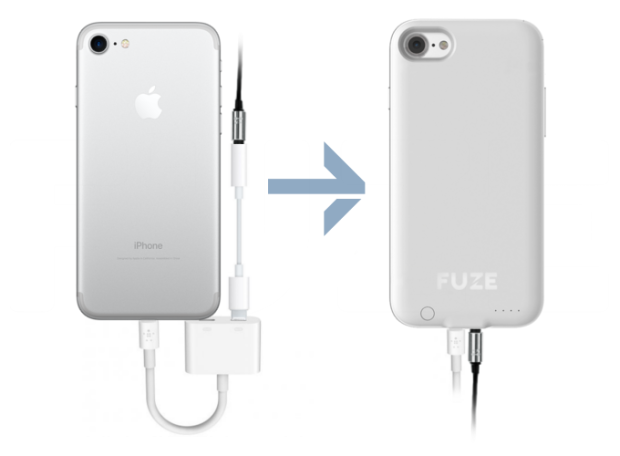
Fuze is a solution – an iPhone 7 case with a 3.5mm socket.


Credit: Fuze/Indiegogo

In common with virtually all smartphones, the iPhone 7 could benefit from better battery life. Fuze adds that too. Double the battery life is claimed.

Unlike other battery cases, Fuze doesn’t add a bulky, “chin”, at the bottom.


Left: iPhone 7 with bulky adapter allows simultneous headphone use & charging. Not shown, charging cable.
Right: iPhone 7 in Fuze case, with headphones & charging cables attached. Note that the Fuze case adds very little length.

Credit: Fuze/Indiegogo

And the 7 Plus hasn't been forgotten.

Fuze is an Indiegogo project. As of this writing, over $119,000 has been pledged, by more than 1600 backers, for over 15,500 cases. Only 6 days left if you want to back this project.

Indiegogo – “Fuze Cases: Bringing Back the Audio Jack”
https://www.indiegogo.com/projects/fuze-cases-bringing-back-the-audio-jack-iphone-headphones/x/9010251#/
/ Fuze Case bringing back 3.5mm audio jack plug socket Fuze first iPhone 7 case integrated Lightning to 3.5mm audio jack adapter Fuze restores 3.5mm audio jack iPhone 7 and 7 Plus doubled battery life scratch and shock protection iPhone’s compact profile bring back the jack purchase freedom of choice Fuze is an innovative case for the iPhone 7 and 7 Plus restores iPhone’s 3.5mm audio jack delivers doubled battery life scratch shock protection maintaining iPhone compact profile no dongles no adapters no problem buy Fuze case iPhone 7 or 7 Plus bring back the jack tangled mess adapters listen to music favorite headphones purchase Fuze purchasing freedom of choice iPhone 7 iPhone 7 Plus glossy surface brighter screen amazing cameras Apple decided kill standard 3.5mm headphone jack headphone socket headphones audio devices besides earbuds tech-experts recommend using case iPhone 7 restore restores iPhone 7 is missing Apple Bluetooth AirPod wireless earbuds Bluetooth earpiece expensive recharge after just five hours of use Apple packaging iPhone 7 with 3.5mm lightning adapter charge IPhone listen to music at the same time Fuze case standard audio jack Fuze industry standard 3.5mm audio out jack every previous iPhone your favorite earbuds battery case Fuze built-in battery double your iPhone 7’s battery life double battery endurance Fuze advanced Sync-Through technology sync and charge sync & charge /

Saturday, 22 October 2016

Energy storage for renewable energy


Sample of the element silicon
Credit: Theodore W Gray/periodictable.com

Some time ago, I wrote about the ideas of Professor Donald Sadoway on why storage is necessary to facilitate widespread use of renewable electricity, & how to do it.1

● “Storage is necessary to make renewables base load.”
● “The problem is the very low price point needed to penetrate this market.”
● “If price is the problem, you have to invent to the price-point.”

● “Usually, chemists pursue the interesting chemistry & leave it to manufacturers to bring the price down by volume.”

● “Confine our chemistry to Earth-abundant elements, that’s how to make it cheap.” — e.g. aluminium (3rd most abundant element on Earth) not platinum

● “To make it dirt cheap, make it out of dirt — preferably local dirt.”
● “Earth-abundant elements & simple manufacturing.”

A team of researchers from Universidad Polytechnic de Madrid has in development, a thermal energy storage system which ticks all of the boxes, with, perhaps the exception of, “simple manufacturing”.

Silicon thermal energy storage is claimed to store more than 1 MWh per cubic metre – 10 times the energy density of existing thermal storage technology using molten salts of elements including potassium, calcium & sodium.

New Atlas: Abundant silicon at the heart of cheaper renewable energy storage system
http://newatlas.com/cheap-solar-energy-molten-silicon/45833/?li_source=LI&li_medium=default-widget
__________

1 Hitchhiker’s Guide 2 Tech: “Innovation in stationary electricity storage (video)”, http://hhg2tech.blogspot.com/2015/01/innovation-in-stationary-electricity.html

2 Fred Senese: “What is the most abundant element?”, http://antoine.frostburg.edu/chem/senese/101/periodic/faq/what-element-is-most-abundant.shtml
/ energy storage abundant silicon cheaper renewable energy storage system Earth crust most abundant element silicon cheaper storage system renewable energy team of researchers Madrid developing thermal energy storage system molten silicon store up to 10 times more energy existing thermal storage options develop technology new generation low-cost solar thermal stations store solar energy urban centers storage current major challenge renewable energy sources wind solar viable alternatives drastic improvements store surplus energy draw energy night times sun isn't shining wind isn't blowing current battery technology develop development developed researchers industry exploring range new ideas improve energy storage commercialized solar thermal energy system stores concentrated heat Sun molten salts potassium calcium sodium nitrates converts heat electricity thermal generator salt-based systems work quite well require complex pumps pipelines heat transfer fluids generate electricity expensive vulnerable safety issues particularly abundant materials scale up plants elements researchers worldwide safer alternatives use cheaper more abundant materials silicon-based solution Universidad Polytechnic de Madrid UPM silicon world's cheapest most abundant elements proposed new thermal energy storage system heating silicon container concentrated sunlight surplus electricity generated renewable power molten silicon reach temperatures around 1,400° C 2,552° F isolated environment until energy is needed heat converted electricity silicon unique properties store more 1 MWh energy cubic meter ten times more energy density than salts key making new system work research leader Alejandro Datas thermophotovoltaic cells new technology solar panels generating electricity from heat light high temperatures silicon intensely shines same way that Sun does thermophotovoltaics convert incandescent radiation into electricity thermophotovoltaic cells conversion efficiencies over 50 percent can produce 100 times more electrical power per unit area than conventional solar cells key to the system can work at extreme temperatures ticks a lot of boxes abundant inexpensive materials store up to 10 times more energy existing solutions extremely compact quiet no moving parts researchers invention dramatically reduce cost storing producing energy thermal energy sector safe cost-effective answer renewable sector energy storage problems used for heating electricity UPM team commercialize commercialise system business project called SILSTORE started building a laboratory-scale prototype /

Friday, 21 October 2016

As of 19 October 2016, all Teslas produced will have the hardware necessary for fully autonomous driving (video)


Yes, you read that right: “All Tesla Cars Being Produced Now Have Full Self-Driving Hardware” – The Tesla Team, 19 October, 2016

and ...

“... at a safety level substantially greater than that of a human driver.”

That’s the good news.

Bad news? – cars made after the 19th can do it, they’re just not going to. Adaptive cruise control & lane keeping, for example, will initially be disabled. And yes, you read that right too.

They’re going to watch the humans get it wrong for a few months.

Point of this is to gather statistics on how much better the fully autonomous system would have done it. To demonstrate how much more capable it is, the new system will be less capable, initially.

Can’t demonstrate how much better autonomous Autopilot is, if it never lets the humans make any mistakes.

One reason Autopilot is expected to be safer than a human, is that it is effectively able to see through the vehicle in front, by bouncing radar underneath. Samsung demonstrated some of the value of being able to see through the vehicle in front last year, with its impractical, “transparent safety truck”.

And if you ever thought you needed eyes in the back of your head, the new Teslas have them + the sides too – 8 cameras provide 360° vision.


Credit: Tesla

In addition to extra sensors, there has been a more than 40 times increase in computing power. This has been inevitable, ever since the comment about the effort required to, “shoehorn”, the last version of the software into the available computer hardware.

“Autonomous”? – Elon Musk has claimed that by the end of 2017 he will be able to demonstrate a vehicle capable of driving from LA to New York with no – that's none, nothing, zero, nada – input from the driver – apart from plugging in a charging cable as required.

Tesla’s announcement: All Tesla Cars Being Produced Now Have Full Self-Driving Hardware
https://www.tesla.com/en_AU/blog/all-tesla-cars-being-produced-now-have-full-self-driving-hardware?redirect=no


Road & Track
http://www.roadandtrack.com/new-cars/future-cars/news/a31237/tesla-autopilot-hardware-standard/

Thanks to Bill for a heads up on material in this item.
/ Tesla cars produced now have full self driving hardware Tesla Team self-driving vehicles play crucial role improving transportation safety accelerating world’s world transition sustainable future full autonomy enable Tesla substantially safer human driver lower financial cost transportation own car provide low-cost on-demand mobility low cost on demand mobility excited announce all Tesla vehicles produced factory Model 3 hardware needed full self-driving capability safety level substantially greater human driver eight surround cameras 360 degree visibility around car up to 250 meters range twelve updated ultrasonic sensors complement vision detection both hard soft objects nearly twice distance prior system forward-facing radar enhanced processing provides additional data about the world redundant wavelength seeing through heavy rain fog dust car ahead make sense data new onboard computer more than 40 times computing power previous generation new Tesla-developed Tesla developed neural net vision sonar radar processing software system view of the world driver alone cannot access seeing in every direction simultaneously wavelengths go far beyond the human senses eight surround cameras provide 360 degree visibility /

Thursday, 20 October 2016

Arctic cities crumble as climate change thaws permafrost


Credit: Roger Bacon/Reuters

In the northern Russian city of Norilsk, almost 60% of buildings are impacted by foundations shifting as permafrost1 melts. 10% of residential building have been vacated.

Most foundation movements happen slowly, & can be managed safely. In some instances more rapid movements place lives at risk, as when a roof collapsed at Norilsk blood bank, breaking both of a doctor’s legs.

Other problems include:

● craters in Siberia, which have been attributed to explosions of methane released by thawing permafrost

● a boy died after contracting anthrax from bacteria released by melting permafrost

● scientific outposts on the northern coastline are disappearing into the sea as permafrost thaws


https://www.wired.com/2016/10/thawing-permafrost-destroying-arctic-cities/
__________

1 International Permafrost Association: “What is permafrost?”, http://ipa.arcticportal.org/publications/occasional-publications/what-is-permafrost
/ expensive dangerous Soviet era housing block Nurd Kamal mosque arctic Russian city Norilsk Yury Scherbakov cracks appearing wall installed two-room flat caused shoddy workmanship walls started cracking floor started incline could feel it tilt Nadezhda carry furniture out of the flat craftsman five-story building 59 Talnakhskaya Street northern Russian city Norilsk sinking permafrost thawed foundation slowly disintegrated March 2015 local authorities posted notices stairwells building was condemned cracking and collapsing structures growing problem cities like Norilsk nickel-producing centre people located 180 miles above Arctic Circle climate change thaws perennially frozen soil increases precipitation Valery Tereshkov deputy head emergencies ministry Krasnoyarsk region almost 60 percent buildings Norilsk deformed climate change shrinking permafrost zone local engineers 100 residential buildings one-tenth of the housing fund vacated damage thawing permafrost slow-motion wrecks patched prevented engineering solutions foundation shifts suddenly put lives at risk cement slabs broke doctor’s legs front steps overhanging roof Norilsk blood bank collapsed June 2015 building maintenance costs cities Russia’s resource-rich north engineers geologists technogenic factors sewer building heat chemical pollution warming permafrost Norilsk most polluted city Russia climate change deepening thaw speeding up destruction Russia establishing new military bases oil-drilling infrastructure across Arctic Greenpeace warned permafrost thawing caused thousands oil gas pipeline breaks were problems climate change Ali Kerimov engineer Foundation Research Production Norilsk study each case separately understand climate change global warming more frequent forest fires flooding across Russia impact permafrost covers two-thirds country’s territory at least seven giant craters discovered Siberia caused thawing permafrost methane explode ground 12-year-old boy Salekhard died from anthrax thawing released bacteria Arctic islands northern coastline scientific outposts disappearing permafrost thaws sea ice melts wave action increases Valery Grebenets Moscow State University department of cryolithology glaciology teaches students horror stories thawing permafrost buckling roads railways soil runoff killing fish release toxic radioactive pollutants contained frozen dams vegetation treeless tundra spots snow early storm warming built gulag prisoners city gets more than six weeks polar night 2 million tonnes snow each winter temperature drop below -51 degrees C -60F average annual temperatures Arctic rising faster anywhere else more than 2 degrees C since 1900 2015 study found increases soil temperatures Russia’s permafrost regions last 50 years soil temperatures Norilsk increased almost 1 degree C between 1999 and 2013 permafrost misnomer deeper soil remains frozen year-round active layer soil extending several feet below surface thaws summer thaws unevenly contorting warping buildings 1960s builders apartment blocks Norilsk drilling holes 100 feet deep pouring reinforced concrete piles stuck into permanently frozen soil below piles lifted building off the ground air circulation cool soil preventing further thawing engineers soil could start warming so much data Norilsk monitoring station showed active layer thawing earlier thickness increased from three feet to five feet climate change increased precipitation adding more moisture soi freezes expands crumbling concrete piles snow covers ground further warms permafrost effect climate change was not accounted for properly building falling thousands people living in buildings which have potential fall Dmitry Streletskiy professor geography George Washington University problem threatens Alaska Canada northern territories Russia has cities so far north buildings coal mining city Vorkuta damaged emergencies ministry’s Tereshkov Salekhard Nadym Dudinka port Yenisei River Norilsk Nickel ships products deformations 100,000 people living buildings critical condition across Russia’s far north Streletskiy fire protection engineer building condemned /